These two “Plymouth” tambour mantel clocks made by Seth Thomas came into my shop just a couple of days apart. They are similar but have different movements. Both have lively hour and half hour strike on two chime rods.
Plymouth was a name that Seth Thomas put on some clocks ca. 1930 – 1950. If anyone has details of this, please let me know.
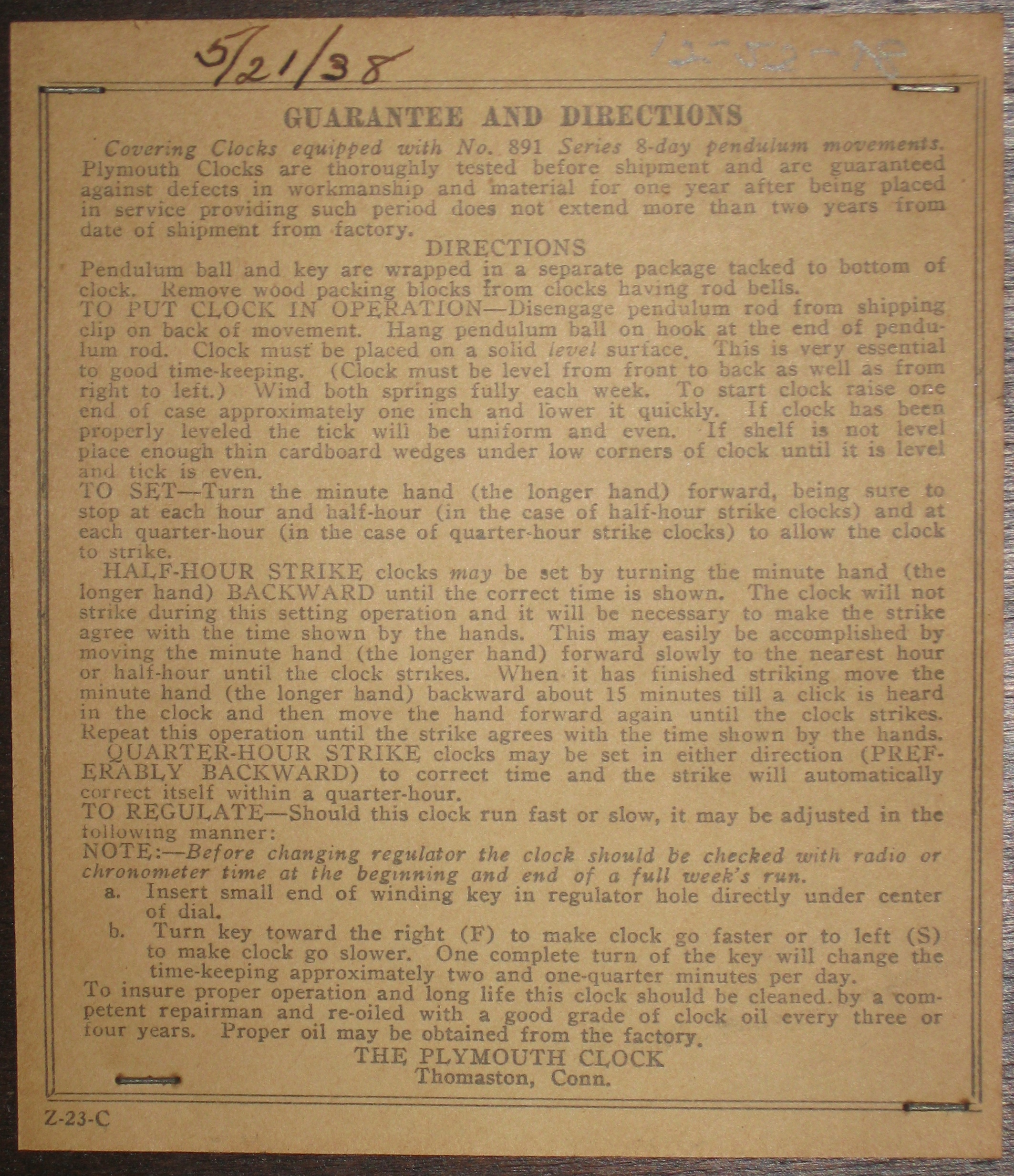
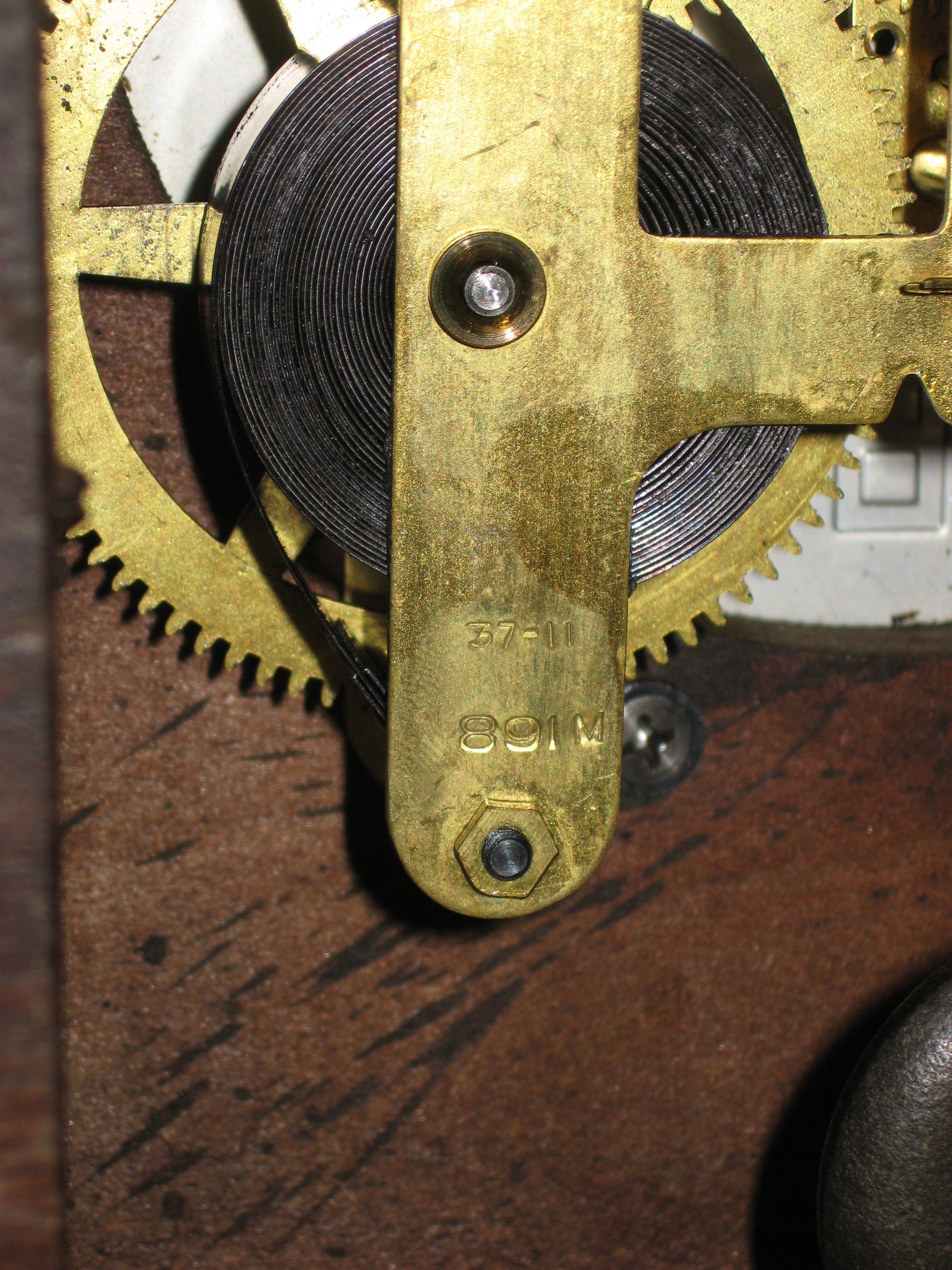
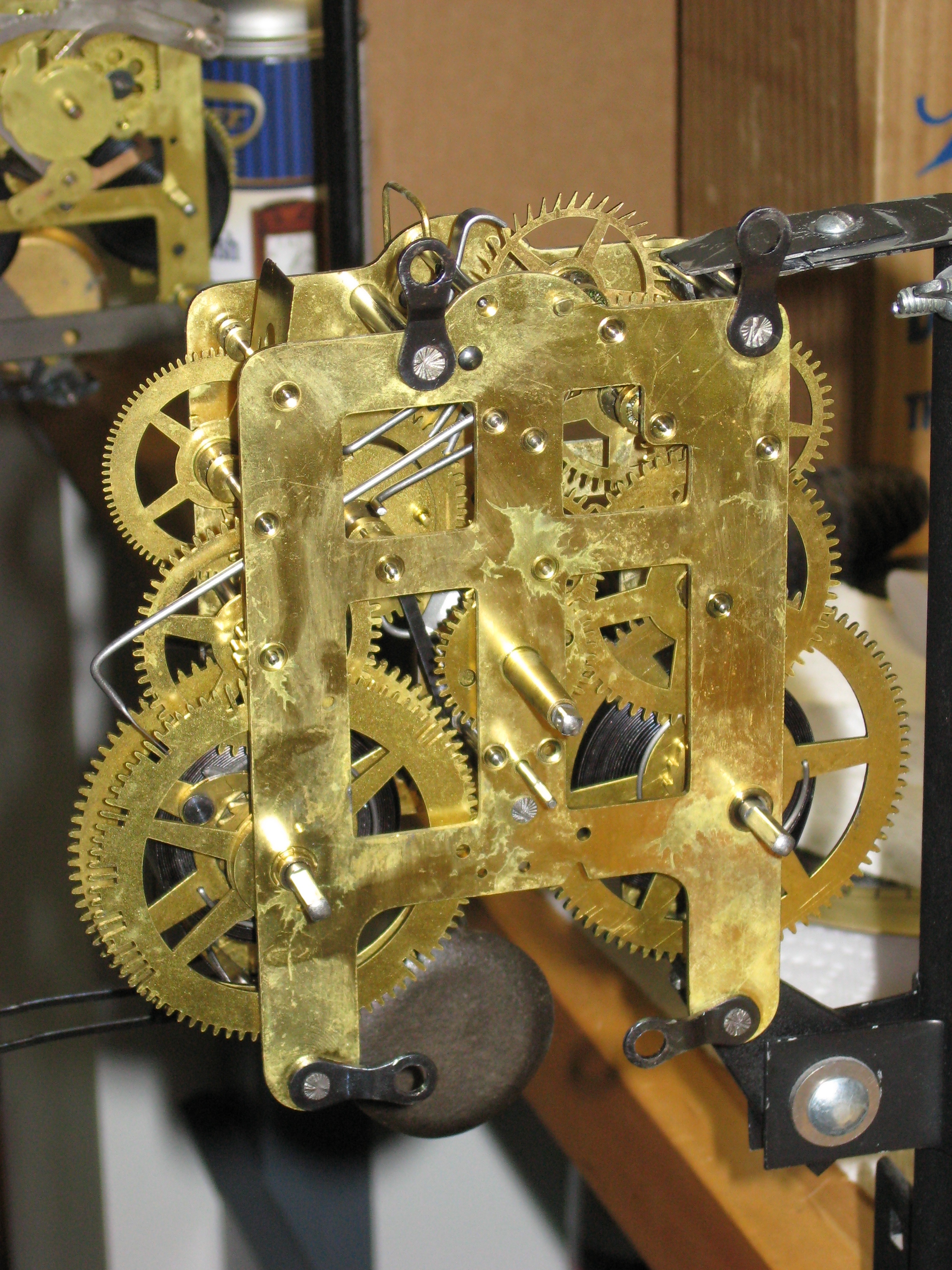
Our first example is labeled 89IM on the movement. This is a variation on the popular No. 89 movement having hour and half-hour strike, with two hammers that simultaneously strike on two chime rods. The date code is 37-11 which represents November, 1937. The label on the back door has the date 5/21/38 (May 21, 1938) hand written on it. This is probably the date the clock was sold.
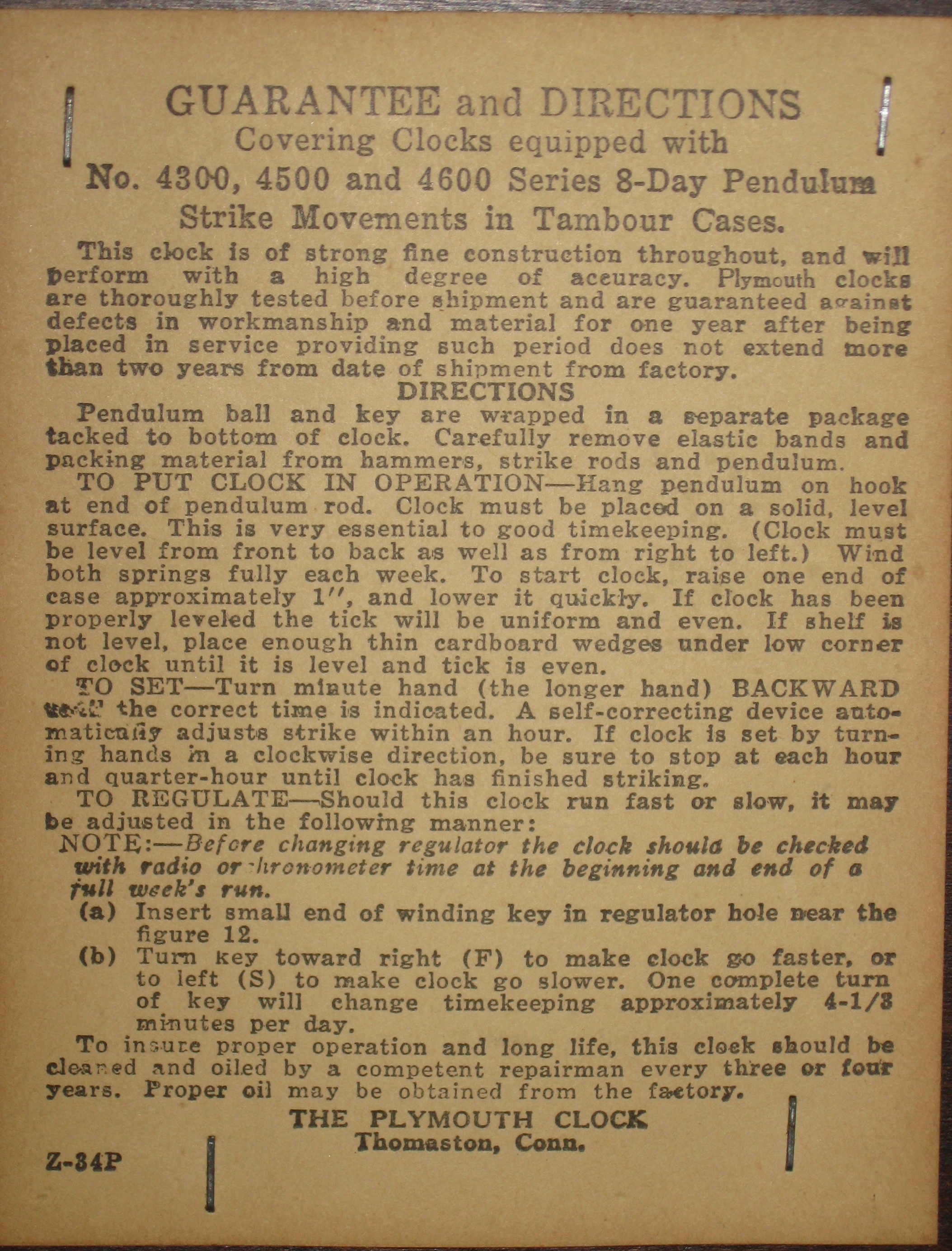
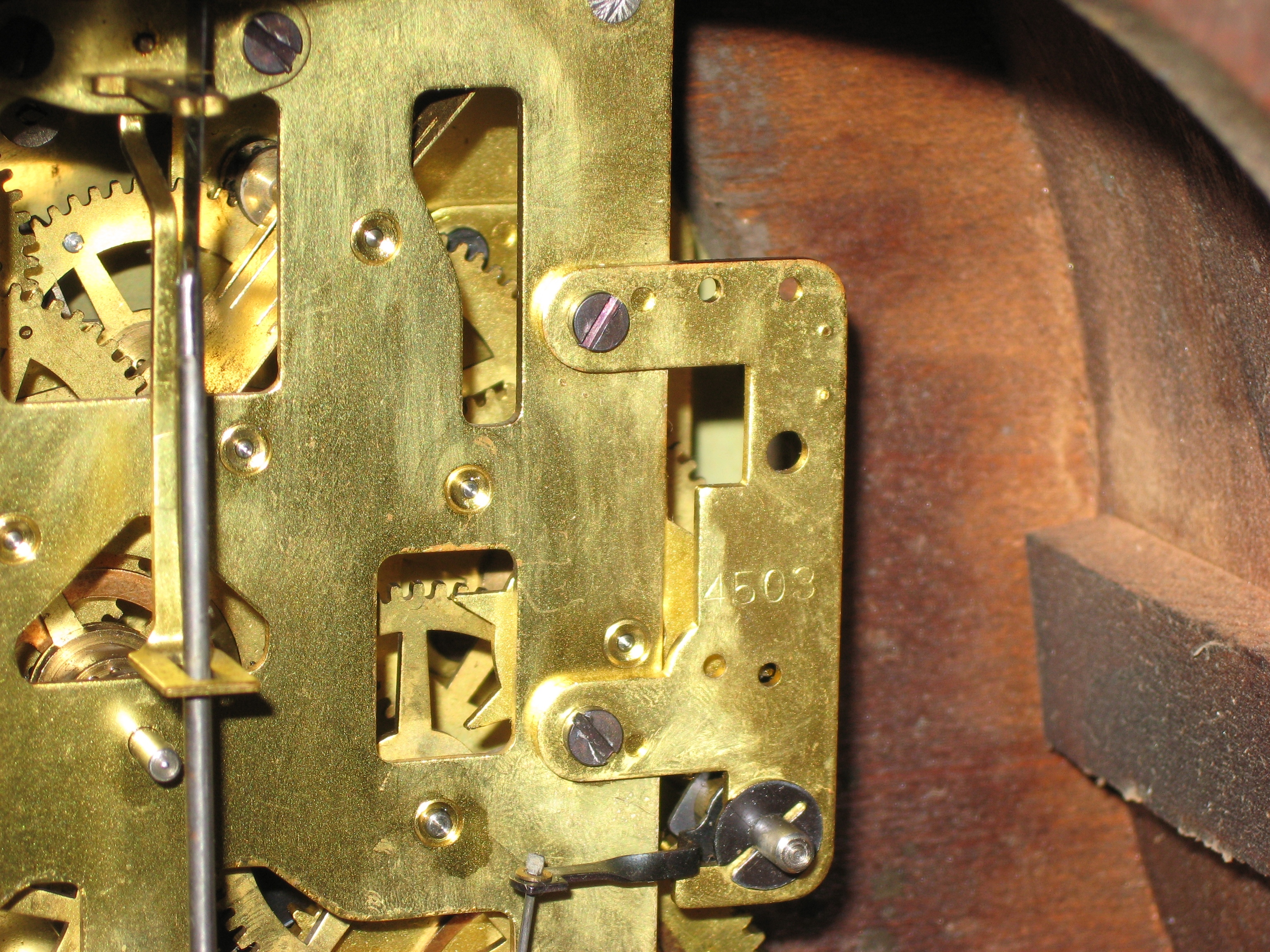
Our second example has the later Seth Thomas time and strike movement that was introduced to save on cost. It is labeled 10-40 (the date code for October 1940) and 4503 (the model number). Similar movements have been seen with model number A-200 on them. The label says:
Guarantee and Directions
Covering Clocks Equipped With
4300, 4500 and 4600 Series 8-Day Pendulum
Strike Movements in Tambour Cases
Both cases are 20 inches wide and 9 1/4 inches tall, with bezels measuring approximately 6 1/4 inches outside diameter. Both have “fake inlay” printed on the case front. Both have aluminum dials. The older dial has embossed numerals, but the numerals on the newer dial are printed only. Both clocks have instruction labels inside the back doors and are illustrated below.






Movement Summary
- The No. 89 movement was introduced about 1900, and was made in many variations.
- It was replaced ca. 1939 with the second movement shown above. This has smaller plates and gears and was probably a cost reduction. It is not as good, as it seems to need quite strong mainsprings to run well. (Note 12-22-2012: The 1938 Seth Thomas catalog lists the No. 89 movement, and I’ve seen an example from 1939 with this newer movement. This newer movement can operate with thinner springs, see my post Plymouth (by Seth Thomas) 1940 Mantel Clock.)
- In 1955, a flood badly damaged the Seth Thomas factory. They phased out movement manufacturing and began importing movements from Germany. They used many Hermle movements.
Share this post:




The rack arbor has a small c-clip on the front plate. This needs to be removed.
Hello Bill. Hoping you can help me. I am attempting to take apart a ST 4500 Movement like one noted above. There are 5 nuts hold the front plate to the posts. I have removed them (springs are clamped), but I cannot separate the front plate.
need akey for my clock but i see different sizes what is the most common key
2 holes at 4 and 8 and one small hole in the middle plymouth 1930
Re: my first comment. I am referring to the movement that is under the picture of the directions dated 5/31/38.
Thank you.
I have this clock with the same movement the is shown under the picture of the Directions. I am looking for a key that will allow me to adjust the slow/fast pin. I have a generic key to wind it but can not fine tune it. Can you direct me?
I have a Seth Thomas Wall mount clock. With code inside 8-87. What does the code mean and maybe the value? Front of Clock shows made in USA and has writing of Seth Thomas and initials underneath name. Numbers are in Roman Numeral.
The movement will need to be removed from the case, and the snail adjusted, to make it strike correctly. It should strike 12 at 12:00 and 1 at 1:00. This is probably a job for a clockmaker.
Plymouth clock 4503 3-39 double hammer strackes together hour and half hour what is the correct strack sequence 1-12 ?”
Have a Seth/Thomas Plymouth hour-1/2 hrs track strackes 12 o’clock at 12 and 12 at 1 o’clock strackes twice at 1 o’clock 3 at 2 o’clock
How can I change that
I have an electric Plymouth mantle clock, movement # 3658, and was wondering if you can give me any info about the approximate manufacture date. Thanks very much.
Need a key and wait, for session mental clock’.,
These clocks are meant to be wound every 7 days, but will run 10 – 12 days on one winding.
How long can a mantel clock like this work with one-time winding?: http://www.mantelclockstore.com
I believe I have an 89-1M with the the date 37-8 stamped above it. I think it is a Seth Thomas. On the original paper on back door at bottom left corner is Z
23C. Then at top hand written is #5593. This is just like one in the pictures with the inlaid #s. My mom bought this for me 40 yrs ago at garage sale. Just would like to know its worth?
If you’re still fielding questions on this clock, mine is a Plymouth. My wife bought it at a garage sale for me. The bottom code on the label says Z23 and the number stamped is 89I or perhaps 891. I don’t see any other markings on it. I’d love to know year and where to get a winding key.
Thank you
Mark
im missing my striker to hit the chime..can you tell me what it looks like? i have a seth thomas ,the inside # on clock is 4509 1-47…thank you
I bought a Seth Thomas Grandfather clock, I wanted to find out what kind, I figured out that it is from 1945 but I dont know what the “H610” or “HG10” means I know that the “4519” means 1945… I can show you pictures.
I have a Plymouth mantle clock that my great grandparents gave to my dad and then to me. I am trying to figure out the date of manufacture. On the movement it has, S-4 and then 891M, and then Z23A on the instruction sheet inside the door. On the bottom of the clock, stamped in the wood is the number 5593. Any help would be appreciated. I also need to purchase a key to wind it.
i have givin all the coments and i was looking for a way to un wind my clock as itws wound to tight./thanks again
have a happy
richard la delia
thankyou for the information and have a great day
richard
Roger Barney
Need;Esape Wheel and Vrage for this movement Plate #38-6
Clockwise (toward F) speeds it up.
I have a 1937 Plymouth mantle clock which needs a speed adjustment (I have the proper key). Which way do I turn the S/F adjustment to speed it up?
Clockwise or counter-clockwise?
I just purchase an 8 day “The Plymouth Clock” It’s a mantle clock with 1/4 hour chimes and Hour.
The Number stamped on the bottom is 5592 and the cclock works have stamped into the metal 89IL 36-5
The clock is in a mahogany cabinet with an embossed letters on an aluminium face. It’s in perfect condition and I am wondering what this clock might be worth.
Thank you for any information I can get on this beautiful clock.
Pam
I just etched these two stampings and definitely have 382 and 5593.
I have a Plymouth mantle clock that belonged to my great-aunt and was given to my mother. It looks exactly like your first example. After reading all the previous posts, Ive checked the bottom of the clock and it looks to be stamped either 332 or 382. Also appears to be stamped ?593. I can tell that something preceeds the 593 bur dannot make out what it is.
The key is no longer with the clock. Is it possible to get a key for this clock?
Thanks
I just purchased a Seth Thomas model E511-003 Lynton 1W. Can someone tell me about this model. It is in nice condition, runs well, chimes, has original key. What might be the value.Thank you.
I have a ST tambour mantle clock with a 120f movement. I know this should be repaired rather than replaced, but if I replace, do you know what movement would be comparable and fit in the case? Perhaps Hermle makes something? The strike is a gong, not a chime. Thanks for any info you might have.
I have a Seth Thomas “Plymouth” Tambour Mantel Clock like the one shown in example 1 .It has the 891M stamped on the movement with a code of S-7 right below. The clock is in excellent condition but probably need to be cleaned. My aunt bought the clock new (she wrote the date 11/15/34 on the label in the back). I bought it from her estate a few years ago after her 100th birthday. I am interested in selling it but am not sure where to go. Any ideas?
I can get you a key and pendulum for $25 including shipping (in the continental USA). The key will be double-ended for winding and regulating. To order, please send a check to:
Bill’s Clockworks
8 W. Columbia Street
Flora, IN 46929
Plymouth tambour mantel clock #4505 (09-41)was purchased @ yard sale with no pendulum nor a key. The movement looks like your 1945 pictured. Can you me locate a key and a pendulum?
[…] run well with weaker mainsprings (see my earlier post for another example of this movement, and this post for another […]
i have seth thomas mantle clock,it is dark wood, it has 4 glass sides it looks old. behine the face,dial,roman # its written,made in germany,two-2 jewel and botton of base it has cat#0783-000 , name strahmore.talley indestries company.thomaston,conn 06787 . do you know its value?
i just got one of the 459A in great shape do you know what the value would be around
I have a seth thomas plymouth mantel clock. It is dark wood w/lighter color inlaid wood. It looks very old but I need more info. The only numbers I can find on inside of door are Z 23 which is on the glued paper from the thomas factory and 10/81/JC which is on those old time label makers that used thick plastic labels like from the 70’s. That’s about all i have. Thanks for any help.
RE: Keys. It’s doubtful that you will find an original key for this clock. It may be helpful to know that the key that winds the clock and chime is similar to a skate key it has an inside diameter the same as a 3/16 square bit screw driver. The other end of the key is much smaller for setting the fast / slow adjustment at the top of the dial. I didn’t have the same size screw driver bit, but it is just smaller than 3/32. This may help if you can find a lock smith or someone that can make one out of tubular metal.
It should be noted that on the back of mine it states you must set the clock counter clockwise or if set clockwise, breifly stop at each quarter hour for the chime to work correctly.
I have a Seth Thomas Clock that is for the mantel and it looks like a boat wheel around the top. It has written on the inside back 4300 4500 4600 8 day pendulum. In the back it has two bars that make the chime. I really need a key for this clock. Can anyone help. Would be happy to send a picture of it.
i have a clock just like the one with the gold bars on it & big gears, its just like one my grandmother had when i was a kid, my brother has the one my grandmother had so when i seen it i had to have it, my clock has 891m 37/6 on it and on the bottom of the clock it has d563 stamped in the wood does anyone know a good clock repairman in the tyler texas area it needs a good cleaning and could you tell me how much its worth i give 75$ for it
Hi!
3 – 39 is probably the date code: March 1939.
The value would be around $200 -$400 in good working condition.
I have this same clock recently purchased from a flea market that is in working condition. The only issue with it is that the face is faded. it says inside the clock that it’s 3-39 we seem to think that this is number 3 of 39 made. Could that be possible? Would you happen to know what the value of this clock would be today?
I have a Seth Tamblour Thomas seral#5636, No. 891, 8-day pendulum,with key, and in perfert condition. What is the value?
Here is information on my clock repair service:
Bill’s Clockworks Clock Repair
The following place can restore the dial:
Dial Restoration
Bill, My 82 year old father has just given me a seth thomas “plymouth” i cant find a date code or very much info on it online. It was mistreated for a long time but still keeps time. I have a couple of questions; could you give me any kind of dollar figure on maintinance for the movement? or even complete maintinance on the wood and face as well. i think it would make a neat heirloom to pass on. I would love any info on this clock that i could maybe put inside of it for future generations to see
[…] is another “Plymouth” tambour mantel clock by Seth Thomas (see this post for two others). This one does not have a date code, I estimate that it is from the early 1930s. It […]
There is no new replacement for this movement. An older clock like this should have the movement repaired, not replaced (unless it is replaced with the same type of old one).
I have a plymouth mantel clock inside the door it says Mo.4300,4500,4600 in tambour cases is that the info i need to replace the movement?
I am looking for a winding key for my seth thomas plymouth model tambour mantle clock. I see from your most excellent and informative website that I need some #s to help locate an appropriate key. The #s on the face are raised. The face is aluminum looking. Is it(the face)suppose to be painted white? There is some tarnish/paint looking material in a few places. There is no printed label on the back inside cover. There are maybe (I’m not home to look at the clock ) 5(?)rods (chimes)in the back on the bottom with a little metal piece that may act as a stabilizer – it folds down across them – when the clock is moved. This clock chimes on the 1/4, 1/2 and full hour with the chime lasting longer at each 1/4 of the hour. I will send you the #s ASAP. I really have no “official” info about this clock. Any referral of info would be apperciated.
Thank you, in advance, for your help.