ClockInfo.com
Commentary about clock repair and clock history (with some tidbits on web site development)

ClockInfo.com

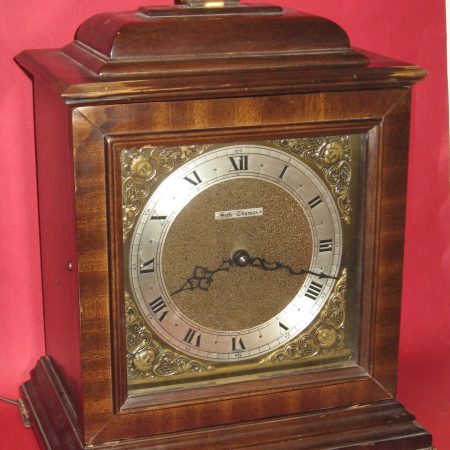
French Quarter Hour Striking Clock

November 16, 2007 . by Bill

In English case, brass plaque on back says:

London, October 17, 1877
I bought this clock of
Elkington & Co.
Edward Livingston Davis

Movement approximately 3-3/4 inch diameter

Case dimensions: 17 inches H, 14-1/2 W, 7-3/16 D

5-1/2 inch dial, silvered brass, painted numerals and time track.

Measured mainspring dimensions

T: 22.3 mm wide (7/8 inch), 0.0138 - 0.014 inch thick, 54 inches long

S: 22.5 mm wide (7/8 inch), 0.013 inch thick, 46 inches long.

The strike mainspring has been shortened, so I calculated the proper size.

Mainspring thickness formula:

L = pi (B squared - A squared) / 2 T

L = Length
B = Barrel inside radius
A = Arbor radius
T = Thickness

Time Barrel
B = 18 mm
A = 5.8 mm
Optimum calculated length: 51.3 inches
The spring was 54 inches long, it looked very old and had no problems, so it was left alone.

Strike Barrel
A = 18,9 mm
B = 6.5 mm
Optimum calculated length: 59 inches
The spring is only 46 inches long, so it must be replaced.

Looking in the R & M catalog, there were springs of .012, .0125 and .013 inches thick that looked correct for the clock. Since new spring are stronger than old springs, I chose the thinest spring, .012″. I felt that there was only a very small chance that this spring would be too weak.

I calculated the optimum length for a .012 inch thick spring: 63.9 inches.

The spring in the catalog is 7/8 inches wide, 0.012 inches thick, 61 inches long. It is shorter than optimum, but considering that a much shorter spring had worked in the clock before, and based on past experience that 8 French clocks are often designed to run around 2 weeks on a winding, I used this spring. It is being tested now, and after 9 days, the striking has not slowed down significantly.

Strike setting up: There must be only a very small run after the last hammer drops, otherwise the quarts will not be struck correctly.

My job 4353.


Herr 400 Day Clock with Rough Pivots

November 6, 2007 . by Bill

I just repaired a standard size 400 day clock by Herr (Horolovar back plate #1159). This clock seems to be a copy of the Schatz standard 400 day clock (movement model 49) but is not as well finished. This clock needed more pivot polishing than most 400 day clocks. Quite often a Schatz 49 will need 3 pivots polished (T2F, T3F and T4F) but this one needed 8 pivots polished (T2 - T5 front and back). Also the verge (pallet assembly) on this clock is not as well adjusted as on the Schatz. When the depth is set so that the drops are equal, the locking is not as deep as I would like. It has a one piece pallet assembly like the Schatz, so you can’t correct the lock by moving one pallet out. I made the best compromise adjustment and the clock runs well.

Another annoying thing with this clock was the process of installing a new suspension spring. A .004 inch thick spring was specified in the book. but it made the clock run slow. The next thinnest available spring is .0038, which is too thin. So I removed the blocks and fork from the spring two times to thin it. Finally after being thinned with 90 stokes of 600 grit abrasive paper, the clock could be regulated.

My Job 4496.


Ingraham Tambour with Quick Release Dial

October 7, 2007 . by Bill

The dial on this Ingraham tambour can be removed very quickly. Instead of the 4 usual screws holding the dial pan to the case, it has 4 studs fastened in the case front, and 4 semi-circular openings in the side of the dial pan which snap over the studs.

Ingraham Tambour with Quick Release Dial

The back door of the case gives these instructions:

TO REMOVE DIAL

The dial of this clock is fastened to the case at four points, opposite numerals 2, 4, 8 and 12 respectively.

To remove dial, open sash, and take off hands. Then with thumb press outward on matting opposite numeral8, at the same time raising carefully on sash. Repeat the operation opposite numeral 10, after which a slight pressure on opposite side of matting will entirely release dial.

To replace, hook one side of dial over two pins in proper location and snap down on other side.

The movement on this clock is dated 9-19 (September 1919). My job no. 4420 (clock not repaired, just lubricated per the customer’s request.)

One of the brass dial mounting studs is located to the right of the winding square in the photo below:

Ingraham Tambour with Quick Release Dial - closeup


Setting Suspension Fork Height on Schatz and Kundo Standard 400 Day Clocks

. by Bill

After repairing numerous Schatz and Kundo standard size 400 day clocks recently, I have noticed that sometimes the optimum suspension fork location is different than that shown in the “Horolovar 400 Day Clock Repair Guide”.

Specifically, for Kundo units such as 1 and 3C, I often find that the fork should be slightly higher. For Schatz units such as 6, 7, 8 or 9, sometimes the fork should be slightly lower.

Assuming that the escapement is properly set up (and it is best to leave the escapement adjustments alone if they have never been changed), and assuming that the clock is “in beat”, the escape arc of the pendulum (the minimum arc or amount of rotation at which the escapement will escape at both ends of the pendulum swing ) should be 1/2 turn.

To increase the escape arc, raise the fork. To decrease the escape arc, lower the fork. (Note: other adjustments will affect the escape arc. For example, bending the anchor pin back toward the suspension spring will increase the escape arc, and vice versa. But I do not recommend bending the anchor pin unless it is clearly already bent incorrectly, as it is fragile and you might break it.)

Note: take the suspension unit out of the clock to raise or lower the fork!

After I assemble a Schatz or Kundo standard 400 day clock movement I wind the mainspring up 1-1/2 turns for initial testing. Then assemble the suspension unit and install it in the clock. Put it approximately in beat. Then give the pendulum 1 turn of motion and time 8 pendulum swings with a stopwatch (it should take 1 minute). Adjust the regulator and retest until 8 swings takes 1 minute (plus or minus 1 tenth of a second). (If necessary, the spring is thinned or a different one installed.) Using the stopwatch allows you to make sure the regulator has enough range to bring the clock to time and give you a good starting point for final regulation.

Next, put the clock in beat and check the escape arc to see if it is close to 1/2 turn. If not, raise the fork to increase the escape arc, or lower it to decrease escape arc. After each adjustment, check the beat again. Finally, run the clock for several hours to make sure it has sufficient power (the mainspring is wound up 1-1/2 turns at this point).

Finally, wind the mainspring fully, let the clock run for an hour as the pendulum arc increases, then make sure the escapement action is correct. Sometimes an escape wheel tooth will fall onto the impulse surface of a pallet immediately after dropping from the opposite pallet (instead of the proper action of landing on the locking surface). This can happen if the fork is too low on the suspension spring or if the locking of the escapement is too shallow. I recommend that you study the “Adjustment of the 400 Day Clock Escapement” section of the “Horolovar 400 Day Clock Repair Guide” for excellent drawings and explanations of the escapement action.

Notes on my experience with escape arc greater or less than 1/2 turn

Several Kundo standard clocks that I repaired recently had only about a 1/3 turn escape arc with the fork in the standard position. They ran fine with the mainspring wound up only 1-1/2 turns. With the spring fully wound, however, the action of the fork was so “floppy” that it rebounded after each impulse, allowing an escape wheel tooth to land on an impulse face of the pallet instead of the locking surface. This caused the pendulum motion to not be as great as it should be. After raising the fork to make the escape arc 1/2 turn, the clock would run well with the mainspring fully wound, as well as wound up only 1-1/2 turns.

Similarly, several Schatz standard clocks had a large escape arc of about 2/3 turn with the standard fork setting. They would not stay running with the mainspring wound up 1-1/2 turns, and did not have much overswing when fully wound. After lowering the fork to give a 1/2 turn escape arc, they ran well both fully wound and wound only 1-1/2 turns.


Ansonia Queen Elizabeth Wall Clock

September 28, 2007 . by Bill

I overhauled an Ansonia “Queen Elizabeth” wall clock, oak case, 37 inches tall, 8 day time only spring driven (my job no. 4446).

4449.jpg

The (probably) original mainspring is 0.0165 inches thick. After the overhaul, the escape arc is about 1.4 times the escape arc.

It is interesting that the movement is mounted tilted in the case.

4449-movt-1.jpg

Note the date Oct. 19, 1899 written in pencil on the label. This is probably the date of sale.

4449-label.jpg


Russell & Jones Hanging Oak Parlor Clock

September 27, 2007 . by Bill

I just overhauled a lovely Russell & Jones hanging oak parlor clock. Height: 28 inches. It has a beautiful glass tablet with an image of a lighthouse. (My repair job no. 4341.)

Russell & Jones Hanging Oak Parlor Clock

Glass of R & J

The movement is 8 day time and strike, with plate size approx. 5-3/8 x 3-3/8

R & J Movement

The original strike mainspring was 0.016 inch thick, it was broken so I replaced it with a Empire 280-19-009 mainspring. The new spring is 3/4 inch wide, 0.0146 inch thick, and 120 inches long. The strike mainwheel has about 10% wear on its teeth. The strike speed is plenty fast enough with this new spring. (Note: I had tried a Merritt’s 3/4x .0155 x 96 inch mainspring, but the striking was WAY too fast).

The original time mainspring was replaced by a previous repairer with a spring that was too strong - 0.0178 inches thick. This strong spring had caused about 50% tooth wear. I installed a Merritt’s Antiques P1496 in the Red and Yellow box. The new spring is 3/4 inch wide, 0.0157 inch thick, and 96 inches long. The pendulum motion is satisfactory and is approximately twice the escape arc. (The movement runs well in spite of the large time mainwheel tooth wear.)

Words on label on back of clock


THE BELLE
——————————
EIGHT DAY HALF HOUR STRIKE, CA
THEDRAL GONG AND ALARM
——————————
Manufactured by

Russell & Jones Clock Co., Pittsfield, Mass, U.S.A.

— For —

N. Y. INSTALLMENT CO.

Chicago, Ill.

R & J Label

History of Russell & Jones

With the failure of the Terry Clock Company at Pittsfield, Mass. in 1888, the Pittsfield businessmen who were large investors, particularly brothers Hezekiah S. and Solomon N. Russell and Edward D. G. Jones, took over the operation. These men and their associates had supplied funds to buy, the bankrupt Terry firm at Waterbury, Conn. in 1880 and move it to Massachusetts in the summer of that year. They built a new factory for the operation in 1883.

By January of 1889, the firm’s name had been changed to Russell & Jones Clock Company and a trade catalog was issued with few changes, if any, from the old firm’s line. In 1890, the new firm issued a new catalog with a substantial number of new and unusual models. As far as can be determined, the firm discontinued manufacture and was disbanded in 1893.

(History written by Chris H. Bailey of the American Clock and Watch Museum, Bristol, Connecticut)

Time train tooth count

Center wheel: 26 teeth

T2: 60/8 (wheel teeth/pinion wires)

T3: 40/8

T4: 40/7

T5 (escape wheel): 39/7

8277.55 beats per hour


Mainspring 3/4 by 0.0145 by 120 Inch

September 23, 2007 . by Bill

Empire Clock Company offers a mainspring specified as 3/4 inch wide, 0.0145 inch thick and 120 inches long. It is part number 280-19-009 and is listed in their parts catalog. Their web site gives directions for ordering their clock parts catalog. This is a good mainspring for many Ansonia clocks.


Dial: Replace or Leave Original?

September 16, 2007 . by Bill

This paper dial is about 90% excellent, with some wear by the numbers 10 and 11. I prefer to leave a dial this good alone. Some restorers would replace it, or a good touch up artist could make it look better in the worn area while leaving the rest alone.

Dial of Ansonia oak kitchen clock

Dial of Ansonia oak kitchen clock

Ansonia Oak Kitchen Clock


« Previous Entries Next Entries »