ClockInfo.com
Commentary about clock repair and clock history from Bill’s Clockworks and ClockHistory.com

ClockInfo.com

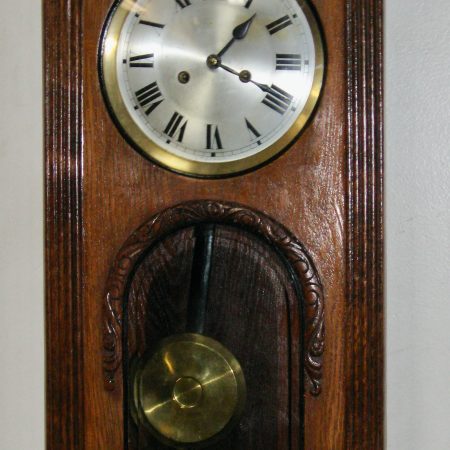
Time and Strike German Wall Clock with Halblang Movement

By on April 19, 2012

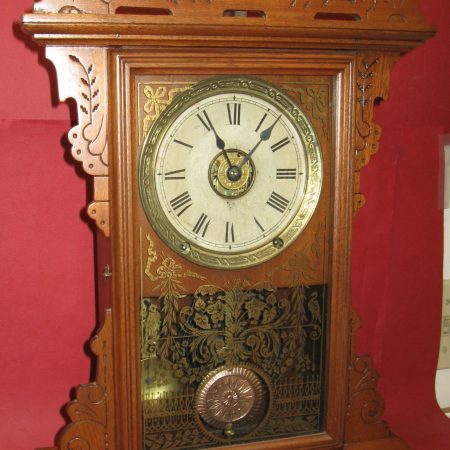
This German time and strike wall clock has a movement labeled “Halblang”. It has very fine fine pivots and pinions, and is similar to those made by Lenzkirch. It is spring driven and strikes the hours on a coil gong.

The case is 23 1/4 inches tall (without the top) and 13 1/16 inches wide. The enamel dial’s minute track is 5 inches diameter, and the minute hand is 2 9/16 inches long.

See more photos.

Repair job 5442.

Related posts:

  1. Hamburg-American German Time and Strike Wall Clock
  2. Hamburg-American German Time and Strike Wall Clock
  3. German Trapezoid Wall Clock, 1960s
  4. German Trapezoid Wall Clock, 1960s
  5. German Wall (Box) Clock

Schatz Standard 400 Day Clock with 54 Instead of 49 in Circle on the Back

By on April 16, 2012

This Schatz standard 400 day clock looks ordinary – but – it has model number 54 instead of 49 in the circle on the back. Movement model 54 normally refers to the Schatz 1000 day clock, and 49 is the model of their standard 400 day clock. I’ve seen several of these mis-stamped clocks, so perhaps a batch of them was made. The circle containing the 54 is 16.2 millimeters diameter, the same as that on the 1000 day clock.

Date 8 54 (August 1954) is stamped on the back.

See more photos.

Repair job S-0631. Overhaul movement, polish pivots, polish base and pillars.

Related posts:

  1. Schatz 400 Day Clock and 1000 Day Clock Suspension Units
  2. Schatz standard 400 day clock, diamond dial, made in 1953
  3. Schatz Standard 400 Day Clock with Narrow Plates
  4. Schatz Standard 400 Day Clock with “Holey” Dome
  5. Schatz Standard 400 Day Clock with Roman Numeral Dial, 1954

Ansonia Long Drop Octagon Clock in Oak Case

By on April 15, 2012

This time-only long drop octagon clock by Ansonia Clock Co., has an oak case 31 3/8 inches tall and 17 1/4 inches wide. The minute hand is 5 9/16 inches long and the paper dial’s minute track is 11 inches outside diameter.

The movement is 8-day time only, and it is interesting that the pendulum is hung from the case backboard a couple of inches above the movement.

The original mainspring is 3/4 inches wide and 0.016 inch thick.

See more photos.

Repair job 5667. Pivots polished, 6 bushings installed.

Related posts:

  1. Original Mainsprings in a New Haven Long Drop Octagon Clock
  2. Ansonia “Queen Elizabeth” Wall Clock in Oak Case
  3. Ansonia Round Drop Wall Clock
  4. A Tale of Three Movements and a Clock (Ansonia Long Drop Regulator A)
  5. Waterbury “Crane” store regulator in oak case

Schatz Square Dial 400 Day Clock, 1954

By on April 14, 2012

I overhauled the movement and polished the base and pillars of this clock. The owner had thought his clock would never look good again:

The movement is dated 4 54 (April 1954) on the back.

See more photos.

Repair job 5724. Horolovar back plate no. 1281. 0.004 inch thick suspension spring.

Related posts:

  1. Schatz Silver Dial 400 Day Clock, 1954
  2. Schatz Square Dial 400 Day Clock, 1953
  3. Schatz Black/Cream Color 400 Day Clock, 1954
  4. Schatz Square Dial 400 Day Clock Made in 1953
  5. Schatz Standard 400 Day Clock with Roman Numeral Dial, 1954

Waterbury Tambour Mantel Clock ca. 1920

By on January 20, 2012

This Waterbury tambour mantel clock was made around 1920. The movement plates are steel that have been given a thin brass plating. Brass bushings were inserted in the plates so that the pivots (steel gear shafts) can turn in brass holes as usual (steel on steel would cause severe wear).

See more photos.

This clock strikes the hours and half-hours on a heavy coil gong. The case is 17 1/8 inches wide and 9 3/4 inches tall. The dial’s minute track is 4 3/8  inch diameter, and the minute hand is 2 1/4 inches from center to tip. The video below shows the clock striking:

When the clock arrived in my shop, the finish had been stripped from the case. I stained it with brown mahogany gel stain, and finished it with spray semi-gloss Deft lacquer.

This movement is a good example of an American clock movement with weak mainsprings. The springs are open (no barrel), 3/4 inch wide, 0.014 inch thick, and about 8 feet long. Many American movements have stronger springs (0.0165 – 0.018 inch thick). A 0.018 inch thick mainspring provides over twice the force of a 0.014 inch thick spring (because the force is proportional to the thickness cubed).

This movement has a strip deadbeat escapement with a very small escape arc (the minimum swing needed for the clock to tick). The running arc is over 3 times the escape arc, showing that the thin springs provide plenty of power for this movement. Unfortunately, it is difficult to find weak enough springs if replacements are necessary. Springs that are too strong will cause wear. The video below shows a closeup of the escapement, and shows the amount of pendulum swing, starting from the minimum:

Repair job 5675.


Related posts:

  1. Waterbury Tambour Mantel Clock with Enamel Dial
  2. Sessions “President No. 3″ Tambour Mantel Clock
  3. Seth Thomas Tambour Mantel Clock
  4. Sessions “Stratford” Tambour Mantel Clock
  5. Sessions Tambour Mantel Clock, Made in 1938.

Schatz 1000 Day Clock, 1956, with 1959 Presentation Plate

By on January 14, 2012

I recently repaired this Schatz 1000 day clock. It is dated 10 56 (October 1956) on the back of the movement, and the front of the base has a presentation plate dated February 8, 1959. The picture on the right, below, shows the gears and the mainspring barrel. Note how large the barrel is compared to the other gears!

See more photos.

Repair job 5647. 0.0024 inch Horolovar suspension spring. Horolovar back plate no. 1010A.

Related posts:

  1. Schatz 1000 Day Clock, 1954, Job 5167
  2. Schatz 1000 Day Clock from 1956 with Original Instructions
  3. Schatz 1000 Day Clock Made in March 1956
  4. Schatz “London Coach” 400 Day Clock, March 1956
  5. A 1954 Schatz 1000 Day Clock

Schatz Diamond Dial 400 Day Clock with Hole in Dome

By on January 14, 2012

This Schatz standard-sized 400 day clock with diamond-shaped dial is dated 7 53 (July 1953) on the back of the movement. This clock has a glass dome with a hole in the top that fits over the brass handle. The base has brass leveling discs. The movement has two jewels (bearings), an uncommon feature in Schatz standard 400 day clocks (but all the Schatz miniature clocks have two jewels). This movement also has an extra mainspring on gear T4 (the 4th wheel in the gear train). It is visible in the left photo below. This is a very weak mainspring, and was used on a relatively small number of clocks. They found that it gave no improvement in performance.

See more photos.

Job 5650. Horolovar back plate 1287. 0.004 inch thick suspension spring.


Related posts:

  1. Schatz Standard 400 Day Clock with “Holey” Dome
  2. Schatz standard 400 day clock, diamond dial, made in 1953
  3. Schatz Diamond Dial 400 Day Clock, 1953
  4. Schatz Diamond Dial 400 Day Clock, Made in May 1960
  5. Schatz Diamond Dial 400 Day Clock Made in 1952

Seth Thomas Tambour Mantel Clock, Adamantine Finish and Bim-Bam Strike

By on January 3, 2012

This Seth Thomas mantel clock from about 1910 – 1920 has an Adamantine (celluloid) wood-grain finish. The movement is marked “89″ and has bim-bam striking on the hour and a single tone strike (the high note only) on the half-hour. The case is 19 7/8  inches wide and 9 1/2 inches tall. The dial is silvered brass with printed numerals and a 4 7/16 inch diameter minute track. The minute hand is 2 3/8 inches long.

I cleaned the movement, polished the pivots, and installed 13 bushings. The pendulum rod and pendulum bob were previous replacements. The clock was losing time, so I shortened the pendulum rod by 3/8 inch.

I replaced the time mainspring because it was causing wear to the mainwheel teeth. I intended to keep the original strike mainspring, but it broke after cleaning and lubrication, as I was winding it into the clamp for re-assembly. The original mainsprings have the following measurements:

Time: 3/4 wide by 0.0185 inch thick (thicker than usual for a Seth Thomas No. 89 movement)

Strike: 3/4 inch by  0.017 to 0.0172 inch thick).

The replacement mainsprings are no. 280-19-003 from Colonial Clock Co., and have the following measurements:

Time: 3/4 inch wide by 0.0158 – 0.016 inch thick by 120 inches long

Strike: 3/4 inch wide by 0.0162 inch thick by 120 inches long.

The movement is a variation on the basic No. 89 having bim-bam strike. It was made before Seth Thomas started giving different model number to variations on the basic movement.

Here is a video showing the pendulum motion and the striking:

See more photos.

Repair job 5640.


Related posts:

  1. Two Seth Thomas “Plymouth” Tambour Mantel Clocks, 1938 and 1945
  2. Late Seth Thomas Adamantine Mantel Clock, 1918
  3. Seth Thomas “Adele” Adamantine Mantel Clock
  4. Seth Thomas Tambour Mantel Clock
  5. Seth Thomas Tambour Mantel Clock with ST Hands

« Previous Entries Next Entries »